
Last updated September 20, 2026
Free on-site gate assessment - hinges, posts, and your LiftMaster or Nice gate operator checked before anything is quoted
The assessment is free and the quote is the invoice.
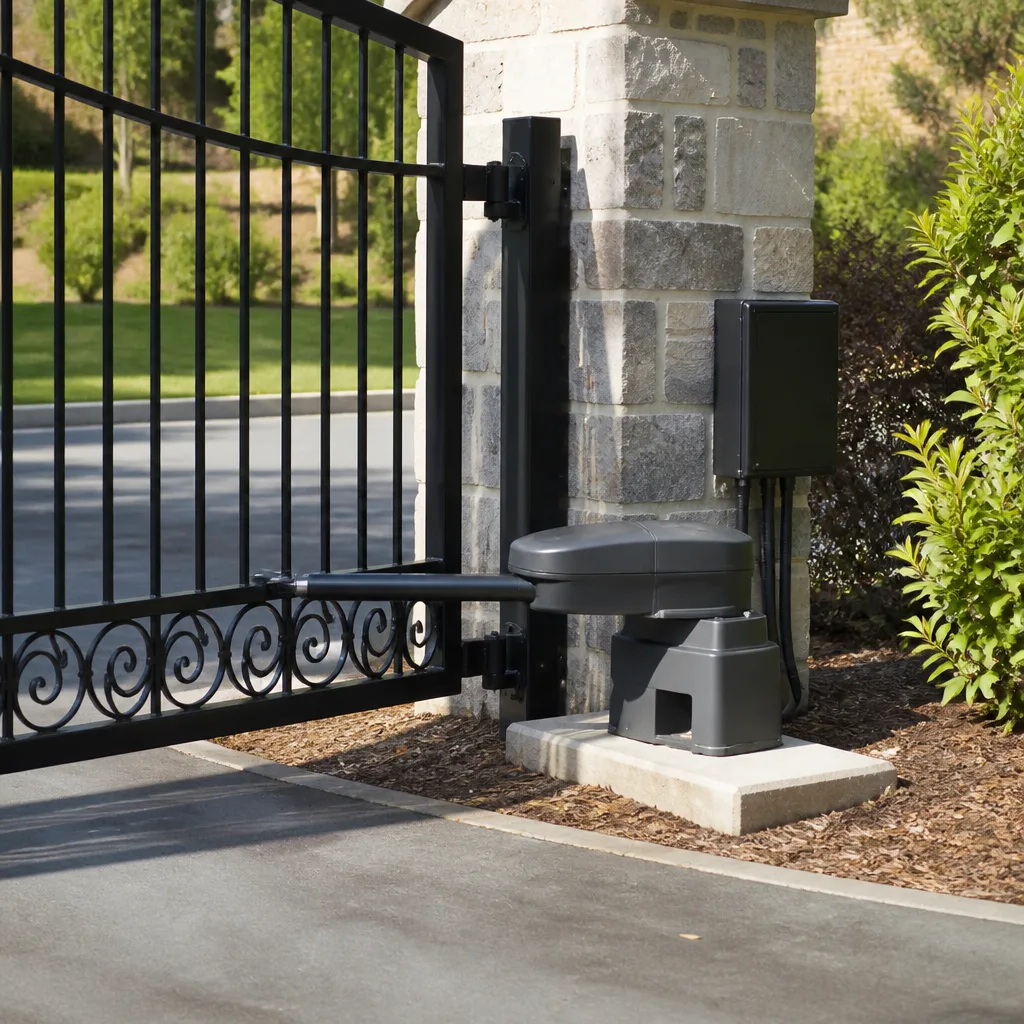
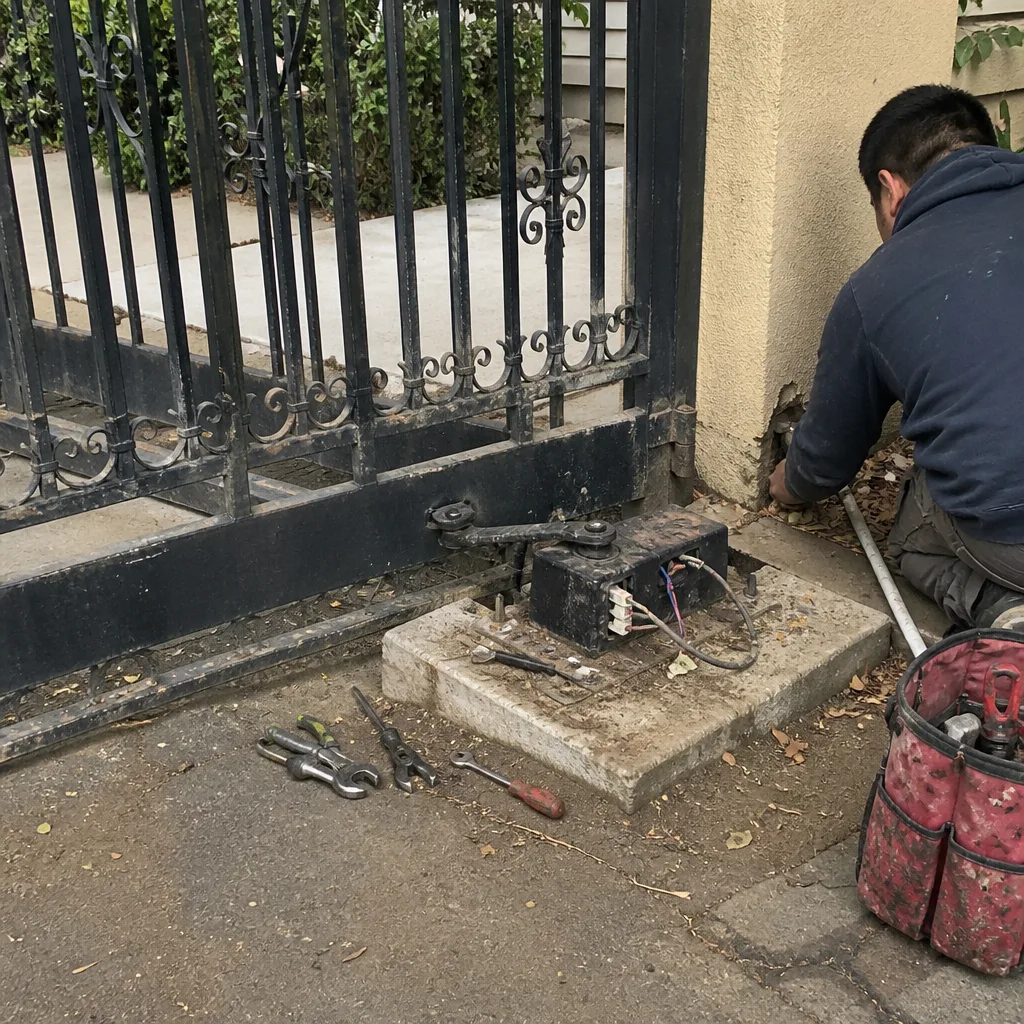 Before
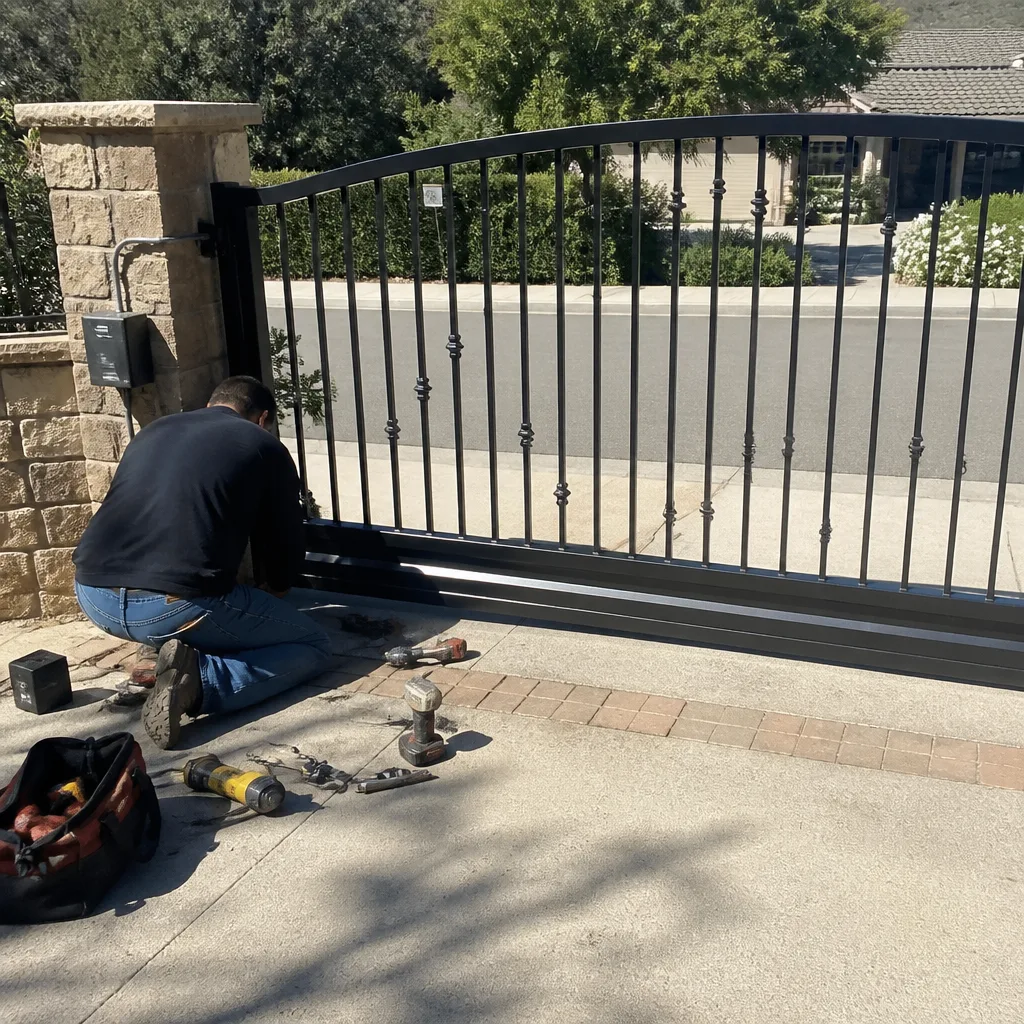 After
After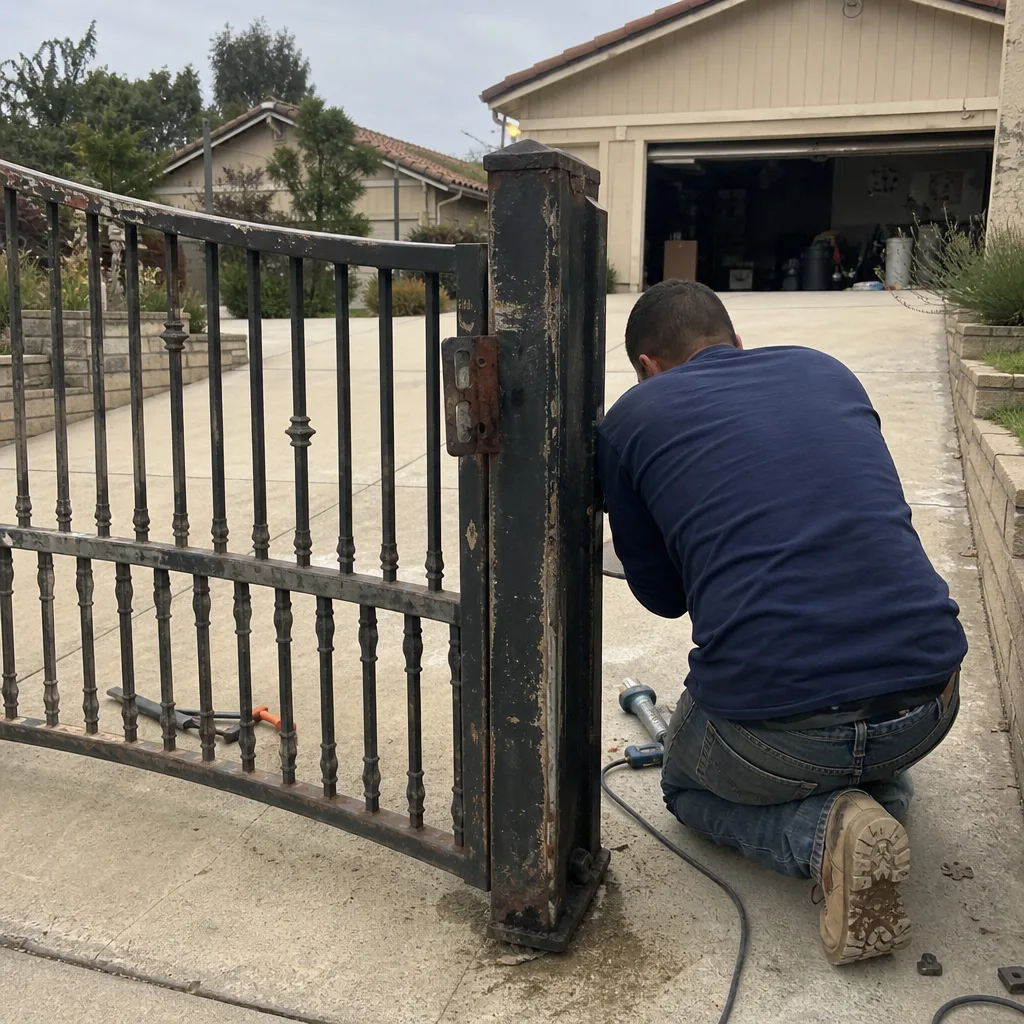 Before
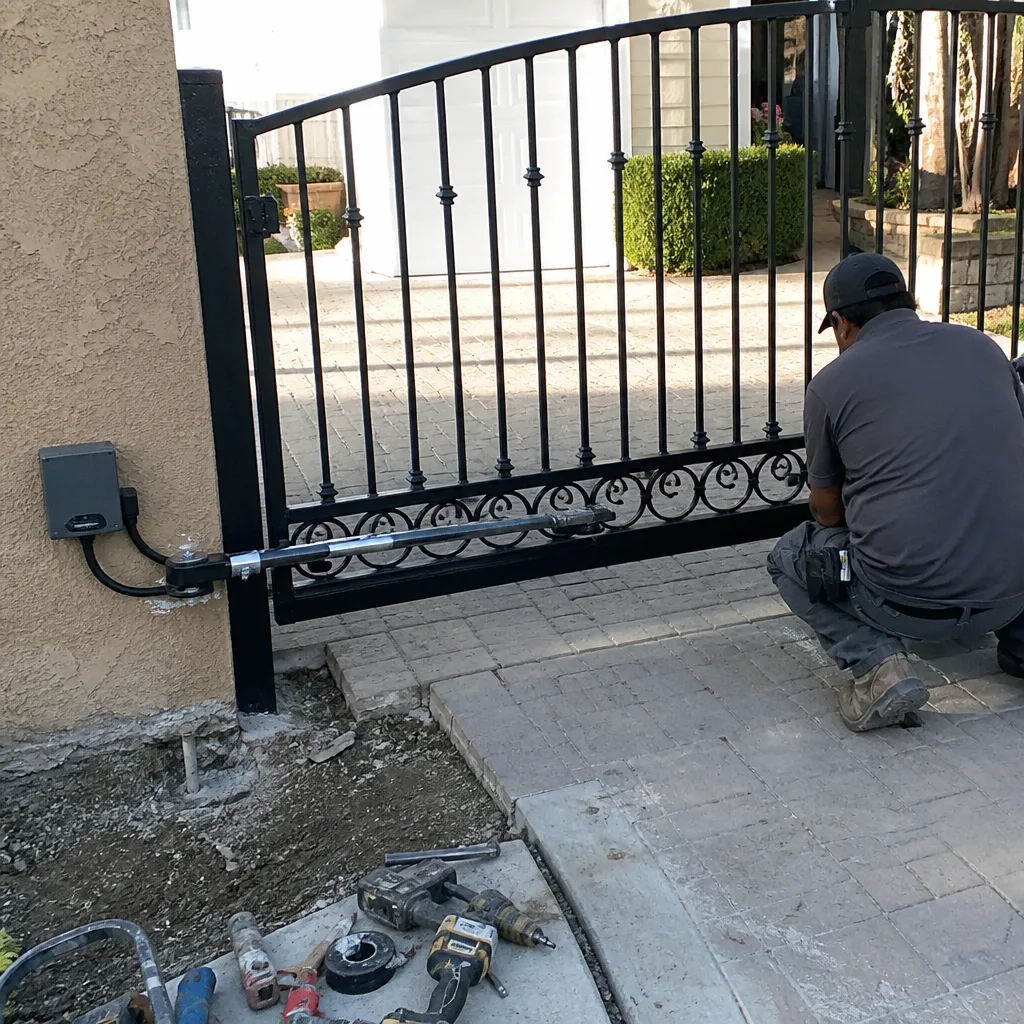 After
After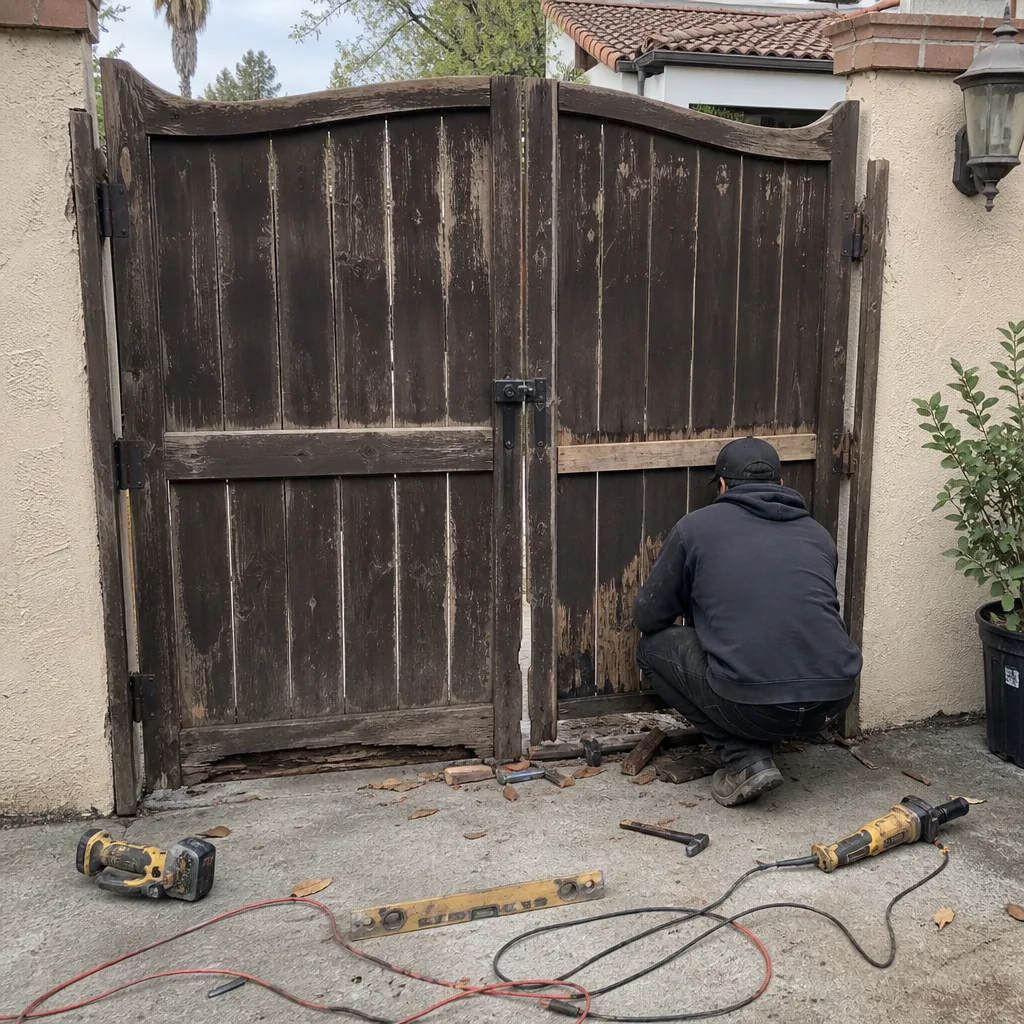 Before
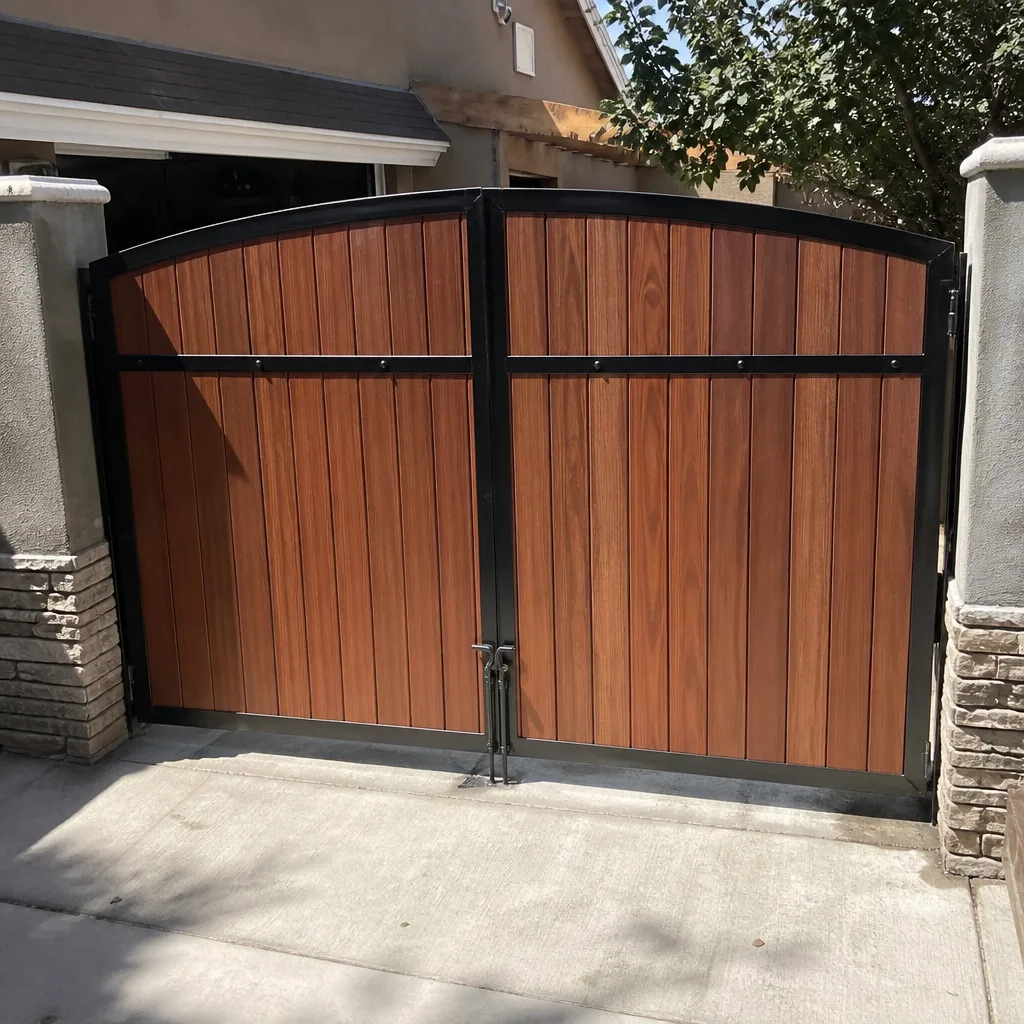 After
AfterGate Repair Warning Signs: A Camarillo Homeowner’s Reference Guide
Most gate guides tell you what a dead gate looks like. That’s easy. The gate won’t open, the motor hums without moving, the remote stopped responding. By that point, you’re already paying for a repair instead of preventing one. This guide is different. It covers what your gate does in the weeks and months before it fails: the two-second hesitation, the change in pitch when the motor runs, the rust pattern that shows up at the terminal block before it ever reaches the control board. If you live in Camarillo, where coastal air and afternoon wind put real stress on gate hardware, these early signals matter more than you might think. By the end, you’ll know which warning signs let you book a gate repair on your own schedule, which ones need attention this week, and how to photograph what you’re seeing so a technician can give you a straight answer before anyone drives out.
Quick Answer
The most reliable gate repair warning signs in Camarillo are a hesitation of two seconds or longer before the gate moves, a change in motor pitch or volume, visible rust bleeding from hinge or terminal-block areas, and relay chatter when the gate isn’t being used. For seasonal gate repair care for Camarillo, these same indicators shift in severity with the weather. Each points to a specific internal problem, and each is cheaper to fix when caught early than when the gate stops entirely. If your gate hesitates and the motor sounds strained, book a repair within 30 days; if you see exposed wiring, a gate that reverses mid-travel, or a photo-eye that won’t hold alignment, call within the week. Most pre-failure repairs in Camarillo run between $150 and $450, while a full motor replacement after failure typically runs $800 to $2,600 depending on the actuator and brand.
Table of Contents
- Why Pre-Failure Warning Signs Matter More Than Failure States
- Mechanical Warning Signs: Hesitation, Pitch Change, and Gap Shift
- Electrical Warning Signs: Beep Codes, Relay Chatter, and Voltage Sag
- Environmental Warning Signs: Rust Bleed, Seal Gaps, and Condensation
- The Stopwatch Test: Using Cycle Count and Hesitation to Estimate Actuator Life
- Scheduled Repair vs. Same-Week Repair: How to Tell the Difference
- Camarillo-Specific Corrosion: What Salt Air Does and Why the 101 Corridor Accelerates It
- How to Photograph and Document a Warning Sign for a Remote Assessment
- Common Mistakes to Avoid
- When to Call a Professional
- Frequently Asked Questions
- The Bottom Line
BeforeAfterWhy Pre-Failure Warning Signs Matter More Than Failure States
A gate that won’t open is a repair you can’t schedule. A gate that hesitates is a repair you can. That’s the entire difference, and it’s the reason this guide exists. Failure states take away your choices: the gate is down, the car is trapped or the driveway is open, and you’re calling whoever can get there fastest. Pre-failure indicators give you something failure states never do, which is time.
In our experience across thousands of gate repairs in Camarillo, the pattern is consistent. A homeowner notices something small; a half-second delay, a sound that wasn’t there before, a slight sag on one corner of the leaf. It doesn’t stop the gate from working, so it goes on the mental list of things to deal with eventually. Three months later the actuator burns out, the limit switch fails, or the gear rack strips, and a $180 adjustment becomes a $1,200 replacement. Every time, the early signal was there.
Here’s the counterintuitive part: gates almost never fail without warning. They’re simple machines in most respects; an electric motor, a gear assembly, a control board, limit switches, and a frame. Each component degrades in a measurable, observable way before it stops working entirely. The problem is that most homeowners don’t know what those measurements are or what they mean. Once you do, the gate starts reporting its own condition to you, and you stop being surprised by failures.
In Camarillo specifically, the pre-failure window is often shorter than in inland areas. Salt-laden air from the Pacific accelerates corrosion at connection points. The temperature swings between cool coastal mornings and hot afternoon sun put expansion stress on joints and seals. Gates near the 101 deal with constant vibration from traffic and accumulated dust from the corridor, both of which shorten the gap between first warning sign and full failure. If you catch a symptom early in Ventura County’s coastal climate, you typically have four to eight weeks to act rather than the two to three months a homeowner in, say, Thousand Oaks might have.
That compression is why this guide treats Camarillo as its own operating environment. The warning signs are universal; the timelines are not.
Mechanical Warning Signs: Hesitation, Pitch Change, and Gap Shift
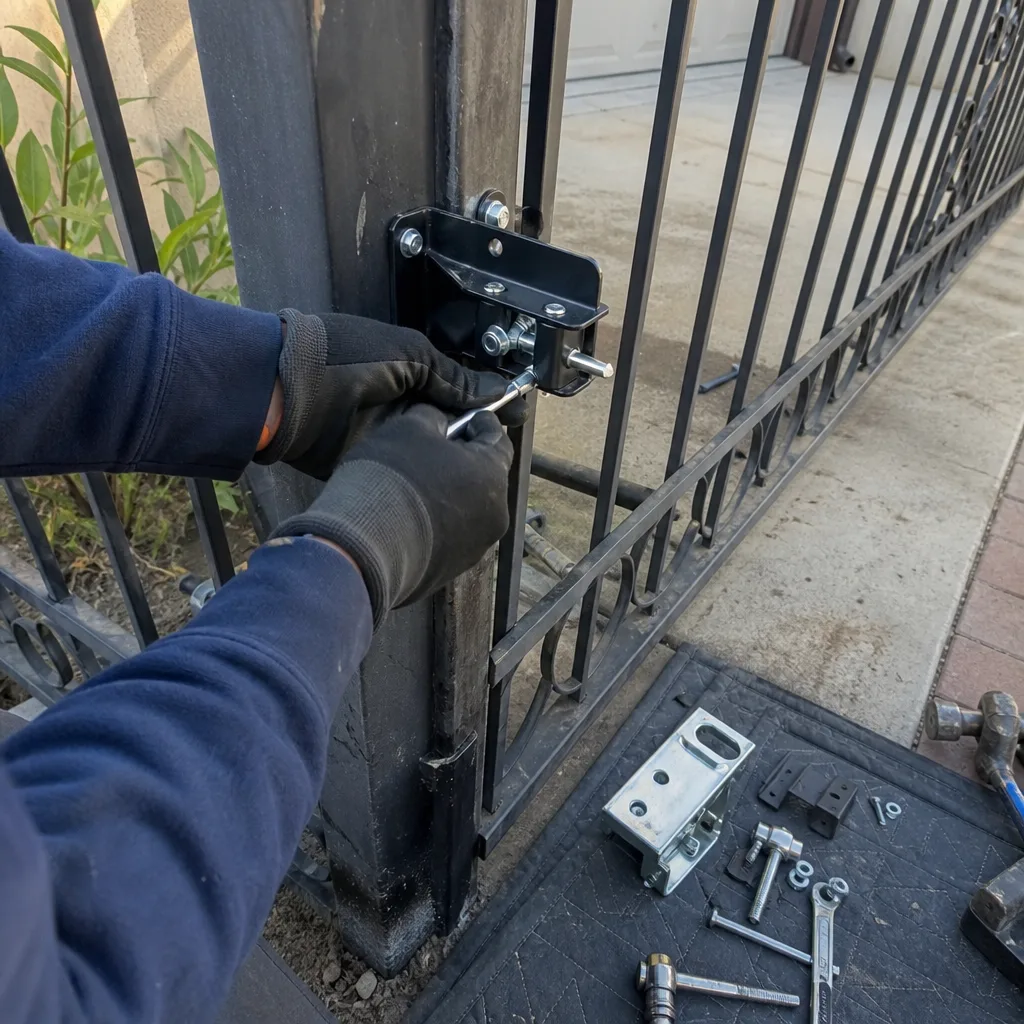
Mechanical warning signs are the ones you can see and hear without opening anything up. They’re also the most commonly dismissed, because they don’t stop the gate from doing its job. A gate that hesitates for two seconds still opens. A motor that whines instead of humming still moves the leaf. But each of these signals corresponds to a specific internal condition, and knowing what that condition is tells you how quickly you need to act.
Hesitation Before Movement
When you press the remote or the keypad and the gate pauses before moving, the motor is working against resistance. That resistance is almost always one of three things: a gear assembly that’s wearing and creating additional friction, an actuator that’s losing torque and needs a moment to build enough force to overcome the leaf’s weight, or a hinge or wheel that’s binding. A healthy gate starts moving within roughly half a second of the signal. A two-second hesitation is the gate telling you the load exceeds what the motor can deliver comfortably. At four seconds, you’re in the final stage before failure. The fix at the two-second mark is typically a gear service, hinge lubrication, or a load adjustment, usually $150 to $350. If you wait until the four-second mark, you’re typically looking at actuator replacement, which starts around $800 on the low end for a residential swing gate in Camarillo.
Pitch Change in the Motor
The sound a gate motor makes is a diagnostic tool. A healthy actuator produces a consistent, low hum under load and something close to silent when the gate is at rest. When the pitch rises, the motor is working harder than it was designed to. When the pitch drops or becomes irregular, you’re hearing a gear train that’s losing smooth contact. A grinding sound is different from a whine and almost always means metal-on-metal wear inside the gearbox. Each of these changes tells you something specific. Rising whine is load-related; check the hinges first, then the gear assembly. Irregular pitch is gear wear. Grinding is the late stage of gear wear and needs attention within days, not weeks. In our work on Gate Repair in Camarillo, pitch change is the single most reliable early indicator of actuator decline, and it shows up months before the motor actually fails.
Visible Gap Shift
Stand at the latch post and look at the gap between the gate leaf and the post. Then do the same at the hinge post. If the gap is wider at the top than the bottom, or wider on one side than the other, the gate’s weight is no longer distributing evenly through the hinges. This is called racking, and it happens gradually as hinges wear, as the post settles, or as the gate frame itself develops fatigue. A gate that racks puts uneven load on the actuator, which accelerates motor wear, and on the latch mechanism, which eventually fails to align. On a steel gate in Camarillo, racking often shows up first as a slight sag on the latch side after a winter of wet ground followed by dry summer soil settlement. The fix is hinge adjustment or replacement, typically $200 to $500, and it’s dramatically cheaper than the actuator failure it prevents if ignored.
Electrical Warning Signs: Beep Codes, Relay Chatter, and Voltage Sag
Electrical warning signs are harder for homeowners to interpret because they happen inside the control board or the motor housing. But they’re observable if you know what to listen for and when to listen for it. These are the signals that most often precede a control board failure, which is one of the more expensive single components on a gate system, typically $400 to $900 for the board alone plus installation.
Beep Codes and Flashing LEDs
Most modern gate operators, including Linear, Viking, and Ghost Controls units we service in Camarillo, emit diagnostic beep codes or flash a pattern on an LED when they detect a fault. These codes are documented in the manual, but too few homeowners ever look them up. A single beep on a Linear actuator might indicate a battery fault in the backup system. A double-beep pattern on a Viking unit often points to a photo-eye obstruction or misalignment. Three beeps on a Ghost Controls system can signal a force limit issue, meaning the gate encountered more resistance than the safety threshold allows. If your gate beeps on startup or intermittently during operation, that’s not an anomaly. It’s a coded report. Write down the pattern, count the beeps, and check the manual. If the manual is missing, a technician can identify the code by brand and pattern over the phone in under two minutes.
Relay Chatter When the Gate Is Idle
A relay is an electrically operated switch. When a relay chatters, it’s opening and closing rapidly instead of staying in one position. You’ll hear it as a rapid clicking from the control board area when the gate is sitting still. Relay chatter usually means one of three things: low voltage reaching the board, a loose connection somewhere in the control circuit, or a failing capacitor that can’t hold a steady charge. The problem with relay chatter is that it generates heat and arc damage at the contact points, which accelerates control board failure. If you hear clicking from the control box when nothing is operating the gate, that’s a same-week item. It’s a relatively inexpensive fix, often a capacitor replacement or a wiring repair in the $120 to $250 range, but left unchecked it becomes a $600 board replacement.
Voltage Sag and Slow LED Response
Voltage sag is what happens when the power supply to the gate drops below what the system needs. The most visible symptom is dim or flickering LEDs on the keypad, or a remote that only works when you’re closer than it used to work. You might also see the gate move more slowly at the end of its travel than at the beginning. Voltage sag in residential gate systems usually traces back to one of three causes: the transformer is failing, the wiring run from the house to the gate has developed resistance (often at a corroded splice point), or the battery backup system is degraded and drawing down the circuit. In Camarillo, where many homes have gate power runs of 50 to 150 feet between the house panel and the gate operator, splice-point corrosion is a common culprit. The good news is that the fix, typically a splice cleaning or wire replacement at the connection point, is inexpensive compared to the downstream damage continuous low voltage causes to the control board.
Environmental Warning Signs: Rust Bleed, Seal Gaps, and Condensation
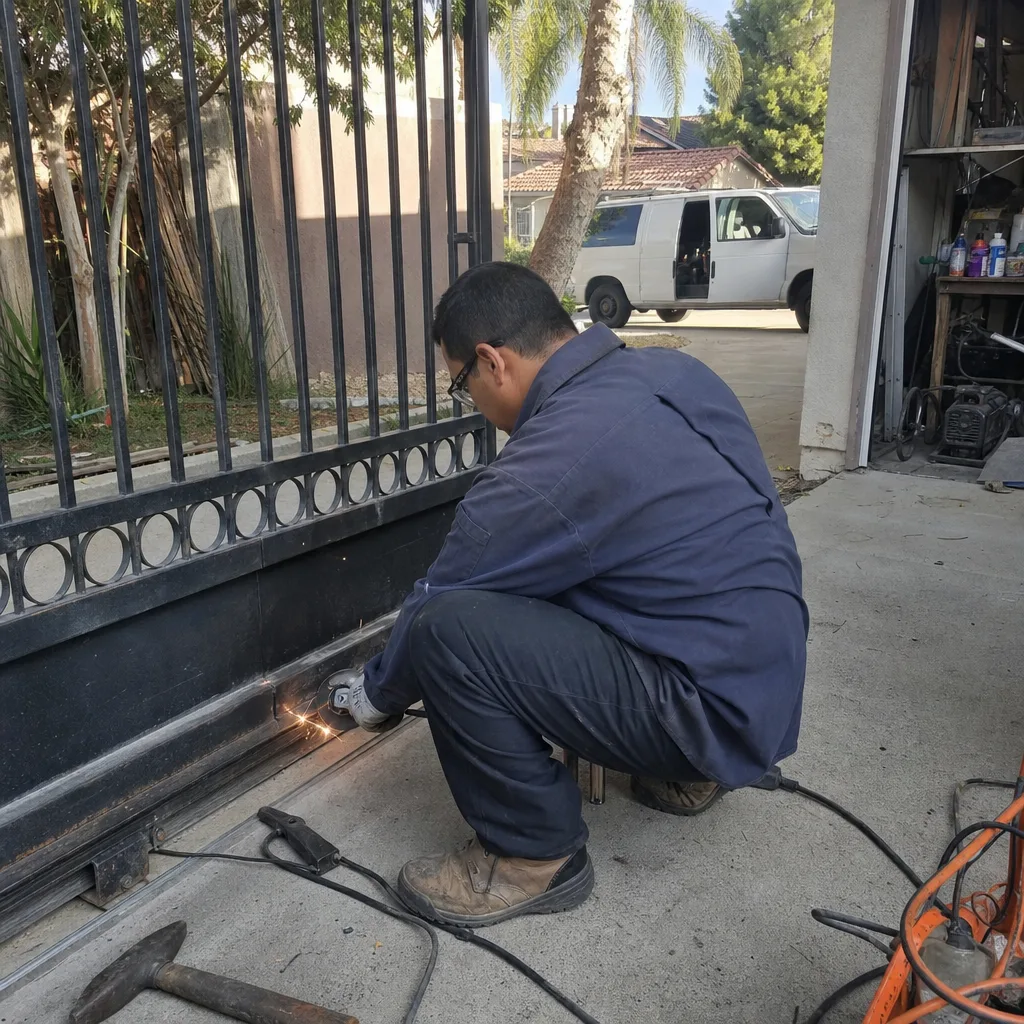
Environmental warning signs are the ones unique to where the gate lives. A gate in Camarillo faces conditions a gate in an inland desert town never does: marine-layer moisture, salt in the air, and temperature swings that cause materials to expand and contract on a daily cycle. These conditions produce visible evidence long before they cause mechanical or electrical failure. Learning to read them is learning to read the gate’s environment.
Rust Bleed at Hinges and Terminal Blocks
Rust bleed is the stain that appears on the gate surface or the surrounding masonry when water and salt penetrate a connection point and corrosion begins underneath. At hinges, it shows up as an orange-brown streak running downward from the hinge pin. At the terminal block where low-voltage wiring connects inside the operator housing, it shows up as green or white crust, which is copper corrosion, often mixed with rust-colored residue. Here’s the key detail: by the time rust bleed is visible on the outside, the corrosion inside has been active for months. Hinge rust eventually causes the hinge to seize, which transfers load to the actuator and accelerates its failure. Terminal block corrosion eventually causes intermittent connection failures, which present as a gate that works sometimes and doesn’t work other times. The terminal block stage is the cheapest point to intervene, typically $100 to $200 for a cleaning and terminal replacement. The control board stage, which follows if the corrosion migrates, is three to five times that cost.
Seal Gaps on the Operator Housing
The operator housing, the box that contains the motor and control board, is designed to keep moisture out. It does that with rubber gaskets and seal strips. Over time, those seals dry out, crack, and lose their ability to close completely. When a seal gap opens, the housing breathes, pulling in moist air that condenses on the electronics when the temperature drops. The visible sign is a gap you can see around the housing lid, often accompanied by cracking or shrinkage in the rubber. It’s a $40 to $80 fix to replace the seal. If left open through a Camarillo winter, the condensation inside becomes a control board failure waiting for the dampest week of the year.
Condensation Inside the Housing
If you open the operator housing and see water droplets on the inside of the lid or on the control board’s plastic cover, that’s condensation. It means the housing is no longer sealed, and every day it sits like that, corrosion is working on the terminals and solder joints. Condensation is also visible from the outside in some conditions: a fogged or cloudy plastic cover on the control board window. This is a fix-now item, not because the condensation itself is an emergency, but because the conditions it creates will turn into an emergency without a clear warning. Sealing the housing and installing a small desiccant pack is a $60 to $120 service call. Replacing a control board damaged by moisture is $400 to $900. In Camarillo’s coastal marine layer, especially during May gray and June gloom, condensation inside gate housings is one of the most common findings in Gate Motor & Opener in Camarillo service calls.
The Stopwatch Test: Using Cycle Count and Hesitation to Estimate Actuator Life
Every gate actuator has a finite number of cycles in it. A cycle is one full open and one full close. Residential swing gate actuators are typically rated for a specific cycle count by the manufacturer, but the real-world number depends on load, environment, and maintenance. Here’s a test any homeowner can perform with a stopwatch and a notebook.
- Measure the hesitation. Press the remote and start the stopwatch at the moment you press the button. Stop it when the gate begins to move. Record the time. Repeat three times and average the results.
- Measure the full open time. Press the remote and time from the moment the gate starts moving to the moment it reaches full open. Record this. Do it three times and average.
- Compare against the gate’s baseline. If you don’t know the baseline, here’s a useful reference: a residential swing gate in good condition opens in 12 to 18 seconds and hesitates less than one second. A gate that hesitates two to three seconds and takes 20 to 25 seconds to open is showing measurable load problems.
- Watch the trend over two weeks. Run the test once a week for two weeks. If the hesitation time is increasing, the load problem is worsening. If it’s stable, the system has settled into a degraded but stable state, which still needs correction but is less urgent.
- Combine with cycle frequency. Count how many times the gate cycles in a typical day. A gate that cycles 20 times a day in a busy Camarillo household puts 7,300 cycles a year on the actuator. Most residential actuators are rated for 20,000 to 50,000 cycles under ideal conditions, but real-world conditions, especially salt air and racked hinges, cut that lifespan by 30% to 50%. If your gate is 5 years old, cycles 20 times a day, and is starting to hesitate, you’re likely in the final 20% to 30% of actuator life. That’s a scheduled replacement, not a panic, but it’s a replacement that should be budgeted for now rather than discovered at failure.
The value of this test is that it replaces vague concern with a number. When you call a technician and say the gate hesitates for 2.8 seconds and takes 22 seconds to open, versus a previous baseline of 0.8 seconds and 15 seconds, the technician has enough information to give you a preliminary diagnosis and a realistic price range before anyone schedules a visit. That’s the kind of information that lets a Camarillo homeowner make a decision instead of guessing.
Scheduled Repair vs. Same-Week Repair: How to Tell the Difference
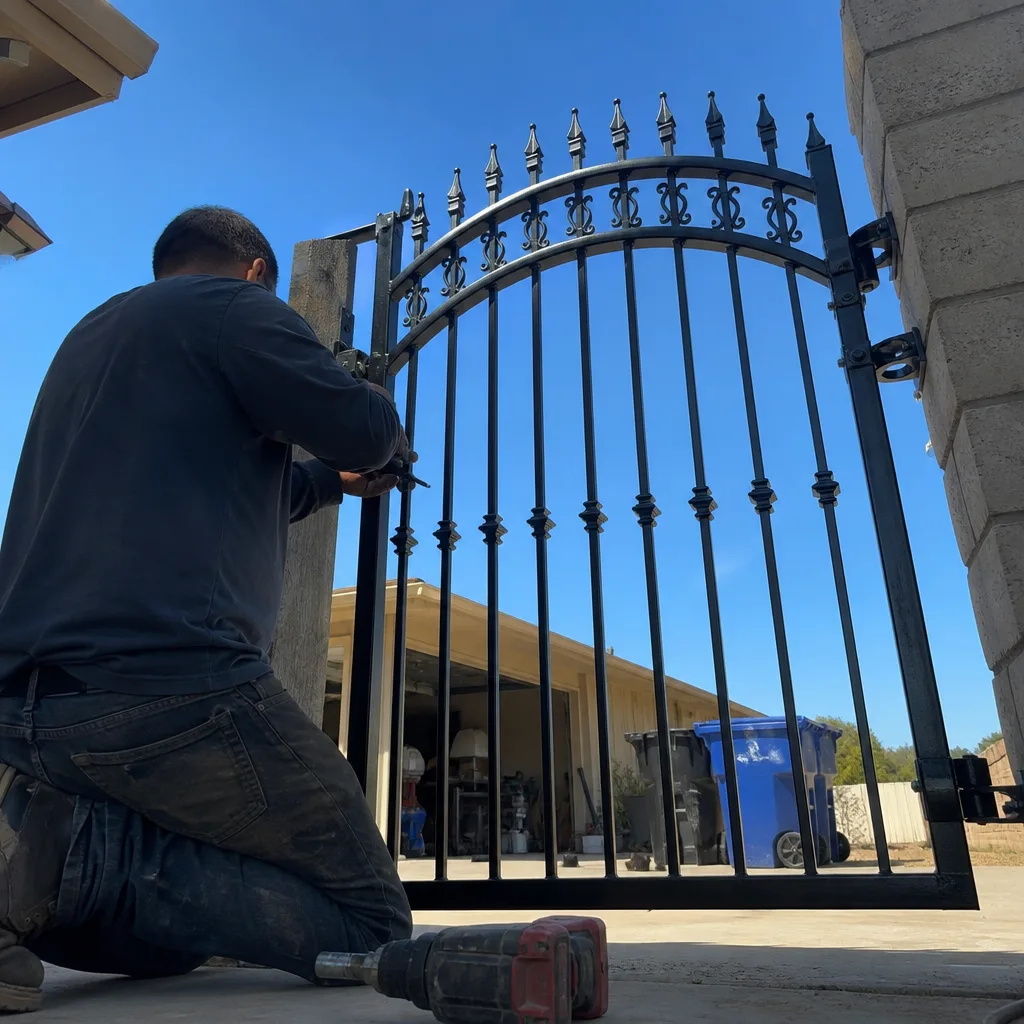
Not every warning sign is an emergency. Treating them all as emergencies leads to unnecessary service fees and rushed decisions. Treating none of them as emergencies leads to failures that cost five times more than the early fix. Here’s the practical framework.
Signs You Can Schedule Within 30 Days
- Hesitation under two seconds with no other symptoms. This indicates early-stage load buildup, typically hinge wear or gear friction. It will worsen, but slowly.
- A consistent change in motor pitch that hasn’t progressed to grinding. The gear train is showing wear, but the gate is still operating within tolerance.
- Rust bleed at hinges without visible looseness or sag. The corrosion is cosmetic at this stage, but it needs to be addressed before it compromises the hinge.
- Terminal block corrosion that hasn’t yet affected gate operation. If the gate still opens and closes reliably, you have a window.
- Fogging or light condensation on the control board cover without visible water droplets on the board itself.
These are items to book on your calendar and address within a month. They’re not emergencies, but they’re also not self-correcting.
Signs That Need Same-Week Attention
- Hesitation over three seconds. The gate is at the edge of its operating envelope. Failure is imminent, and the failure mode is unpredictable.
- Grinding or metallic scraping sounds. Gear teeth are degrading. Every cycle removes more material.
- Relay chatter when the gate is idle. The control board is being damaged in real time.
- Visible arcing or burning smell from the control box. This is a fire risk and a control board failure in progress.
- Gate reversing mid-travel without an obvious obstruction. The force limits or the photo-eye circuit are malfunctioning, which is also a safety issue.
- Exposed wiring anywhere in the system, especially low-voltage wiring that runs underground from the house to the gate.
These items carry safety risk or expensive-failure risk, and they escalate quickly. If you see any of them, calling same-week isn’t overreacting. It’s protecting the most expensive components on the system.
Camarillo-Specific Corrosion: What Salt Air Does and Why the 101 Corridor Accelerates It
Camarillo sits in a specific climate band. It’s far enough inland to avoid the daily salt spray of a beachfront property, but close enough to the coast that the marine layer reaches it regularly. That means salt in the air, but in a form that’s less visible than what a Manhattan Beach or Oxnard homeowner sees. The salt doesn’t coat the gate in a visible film. It settles into connection points, hinge pins, and terminal blocks, and it works silently.
The failure sequence is predictable. Salt and moisture create a mild electrolyte solution at any exposed metal contact point. That solution accelerates galvanic corrosion between dissimilar metals, which is exactly what a terminal block is: copper wire under a steel screw. The corrosion begins as a green or white crust on the terminal, which increases resistance at the connection. Increased resistance generates heat. Heat accelerates corrosion. Eventually the connection becomes intermittent, and the gate starts behaving erratically: working in the morning, failing in the afternoon, tripping the safety circuit for no apparent reason. This is the stage where most Camarillo homeowners first call for help, because intermittent failures feel like ghosts. The reality is corrosion at a connection point, and it’s routine to diagnose and fix.
Proximity to the 101 adds a second factor: vibration and dust. Gates in neighborhoods near the corridor, from the Mission Oaks area up through the Las Posas corridor, absorb constant low-level vibration from traffic. That vibration works on every bolted connection, every wiring termination, every limit switch setting. Combined with the corrosive environment, those connections loosen and corrode on a faster timeline than the same gate would experience three miles south. The practical implication is that a gate near the 101 should be inspected more frequently, and a documented service history matters more in that zone than it does in the quieter residential pockets.
When we work on gates in Camarillo, we look at the terminal block first. It’s the canary in the coal mine for coastal corrosion. A clean terminal block on a five-year-old gate tells us the seals held and the owner has been diligent. A corroded terminal block tells us moisture has been present, the housing seal has likely failed, and the control board is next. Under Vance Gate Repair Camarillo home service protocols, we photograph whatever we find at that terminal block and include it in the record, because the corrosion pattern tells the next technician something important about the environment the gate lives in. That’s the same habit Adrian Vance carried over from commercial access-control work starting in 2014: document what you found, not just what you fixed.
How to Photograph and Document a Warning Sign for a Remote Assessment
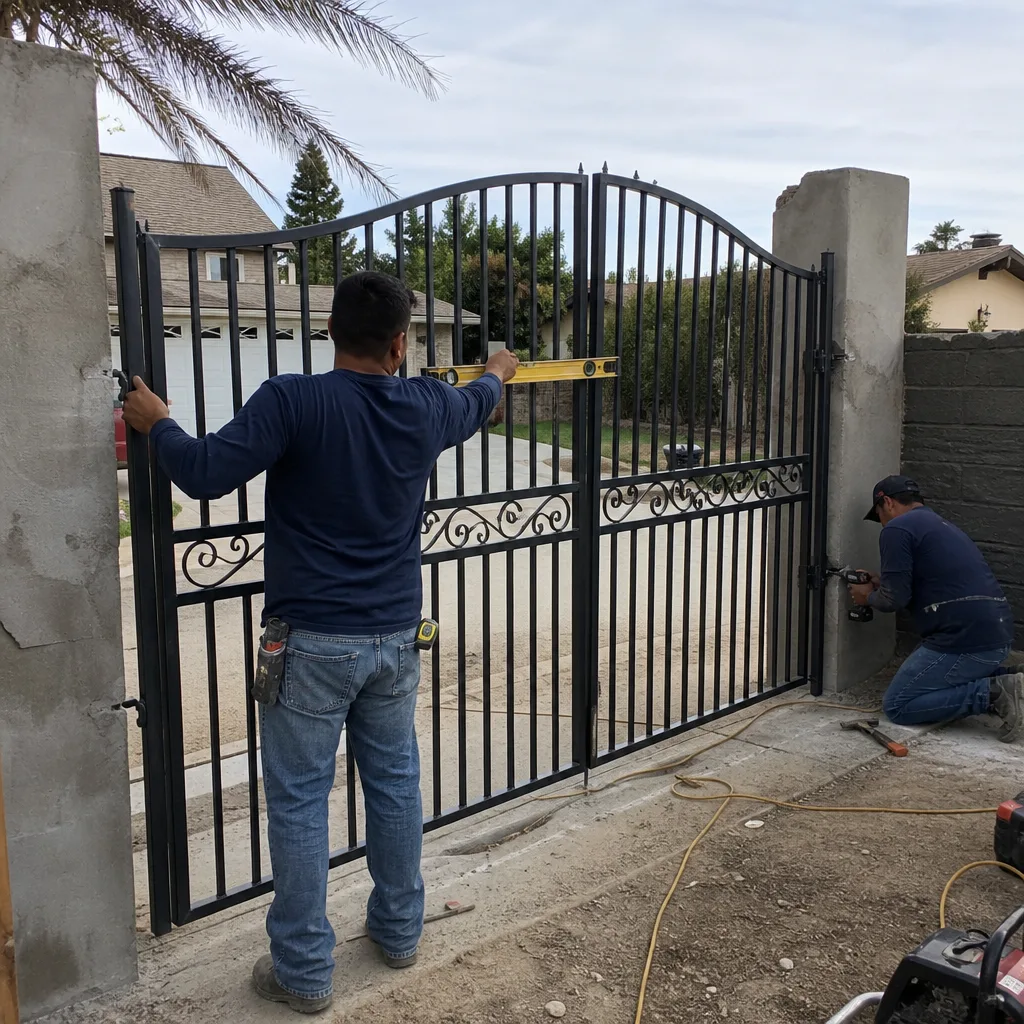
A good photo record does two things. It gives a technician enough information to make a preliminary assessment by phone, and it creates a timestamped baseline you can compare against later. Here’s how to do it well enough that a remote assessment is actually useful.
- Photograph the overall gate from two angles. One straight-on from the driveway, one from the hinge side. These give context for racking, sag, and general condition. Make sure the gap between gate and post is visible in at least one shot.
- Photograph the specific symptom. Rust bleed on a hinge? Fill the frame with it. Terminal block corrosion? Open the housing and shoot the terminal block from six inches away. Condensation on the control board? Get the clearest image you can without touching anything.
- Record a video with sound if the symptom is audible. Open the gate and film the motor housing while it runs. Relay chatter, grinding, pitch change; all of these are captured better on video than in a written description.
- Write down three numbers. Hesitation time in seconds, full open time in seconds, and number of cycles per day (estimate is fine). Add the gate’s age in years, the brand name on the operator, and the model number if it’s readable.
- Send all of it together. Send the photos, the video, and the numbers in one message when you call. A technician can often give you a probability-based preliminary diagnosis, a realistic price range, and an honest urgency assessment from that package alone.
This process saves everyone time, but more importantly, it protects you. When you document a warning sign and send it before a service call, the technician arrives with context. They don’t have to spend the first 30 minutes rediscovering what you already found. That’s the underlying principle behind what we call The Haven Standard as it applies to Gate Installation in Camarillo and repair work: evidence first, then action, and the evidence belongs to the homeowner as much as it belongs to the technician.
Common Mistakes to Avoid
- Ignoring a sound because the gate still works. A pitch change is the earliest signal of gear wear. Fixing it early is a $150 to $350 gear service. Ignoring it until the gate fails is an $800 to $2,600 actuator replacement. We see this progression weekly in Camarillo.
- Lubricating without cleaning first. Adding new lubricant on top of old lubricant mixed with Camarillo dust creates an abrasive paste that accelerates hinge wear. Clean the hinge pin with a solvent, then lubricate with a dry or silicone-based product.
- Adjusting the force limit to fix a hesitation. Raising the force limit on a Linear or Viking operator makes the gate move faster, but it masks the underlying load problem and stresses every component downstream. It’s a temporary fix that shortens actuator life.
- Waiting for the gate to fail before calling. The single most expensive decision a homeowner makes is treating early warning signs as non-urgent. A $200 hinge service becomes a $1,400 actuator plus hinge job when the failure cascades.
- Ignoring the photo-eye alignment. A misaligned photo-eye causes the gate to reverse mid-travel or refuse to close. It’s a five-minute fix, but homeowners often tolerate it for months, adding unnecessary cycles and heat to the system.
- Assuming the manual covers everything. A DoorKing manual, for example, documents the beep codes, but it can’t tell you that the beep you’re hearing is caused by corrosion at a specific terminal that’s common in coastal environments. Manuals are references, not diagnostics.
- Skipping the photo record. If you photograph a warning sign when you first notice it, you have a baseline. Without that baseline, a technician has to guess whether the condition has worsened since you first saw it. Guessing costs time and money.
When to Call a Professional
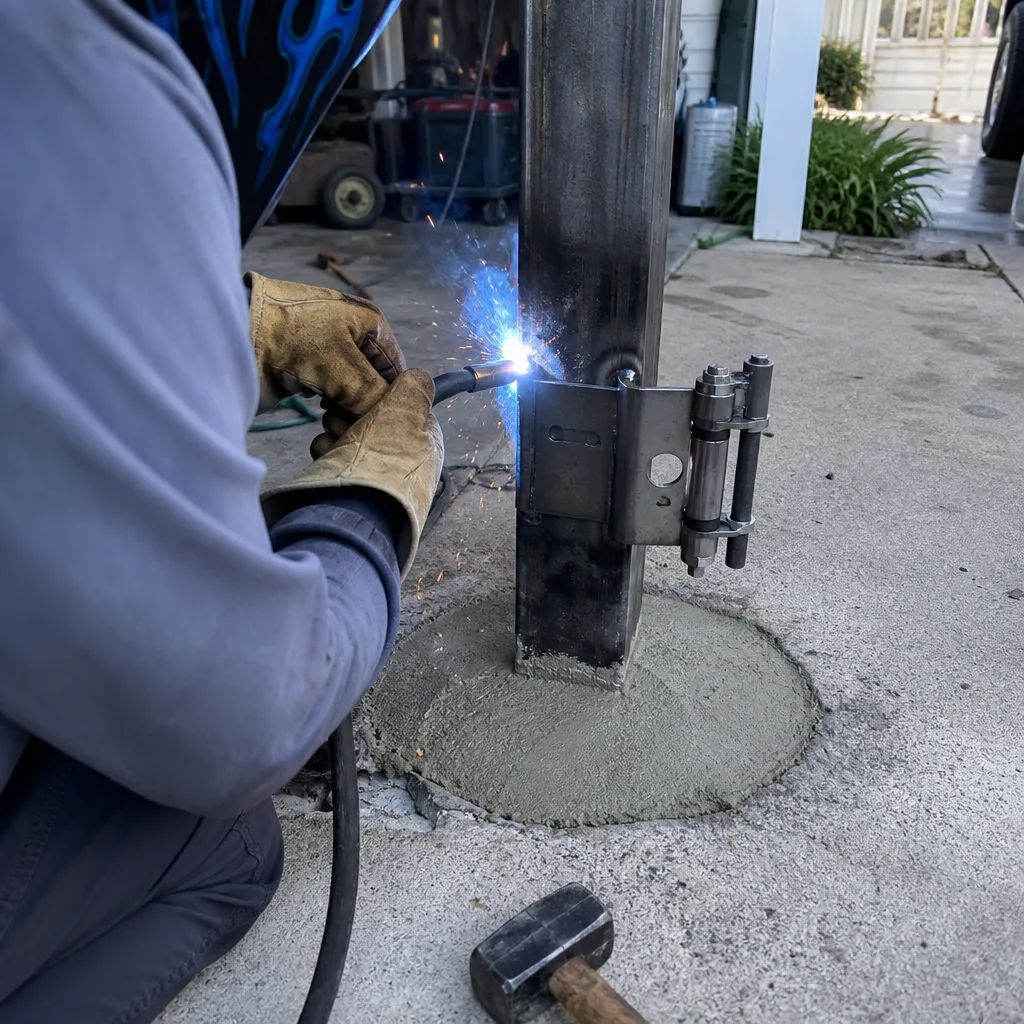
Any grinding sound, any hesitation over three seconds, any relay chatter, any visible arcing, or any exposed wiring is a call-now situation. These are the symptoms that precede the expensive failures, and they don’t self-correct. For less urgent symptoms, call when you first notice them and can describe them precisely. A two-second hesitation documented at week one gives a technician a baseline that makes the week-eight visit more valuable. Vance Gate Repair Camarillo offers free estimates in Camarillo; call (805) 516-0855 and describe what you’re seeing and hearing. We’ll give you a straight answer about urgency and a written price before anyone picks up a tool.
Frequently Asked Questions
Most pre-failure gate repairs in Camarillo run between $150 and $450. Hinge service, gear adjustments, terminal block cleaning, and seal replacement all fall in that range. Actuator replacement runs $800 to $2,600 depending on the brand and whether it’s a swing arm or slide operator. Control board replacement typically runs $400 to $900 including labor. A written price before work starts is standard practice at Vance Gate Repair Camarillo, so you’ll never owe more than the number you agreed to. Call (805) 516-0855 for an exact quote on your gate.
Yes. A live person answers the phone 24 hours a day at (805) 516-0855, and we’ll give you an honest arrival window for a technician in Camarillo. If the gate is stuck open and creating a security problem, or stuck closed and trapping a vehicle, we treat that as a priority call.
A full gate installation in Camarillo includes the gate leaf or leaves, posts, hinges, an actuator matched to the gate’s weight and cycle frequency, a control board, safety photo-eyes, and a keypad or remote system. It also includes the wiring run from your electrical panel to the gate operator. The price depends on material (steel, aluminum, or wrought iron), gate width, and whether it’s a swing or slide configuration. A written scope and price come before any work starts.
In Camarillo, this pattern usually points to terminal block corrosion or a loose connection that responds to temperature changes. The marine layer keeps things damp and cool in the morning, which actually improves conductivity at a corroded connection. As the day heats up, materials expand, the connection opens slightly, and the gate fails. It feels random, but it’s a predictable electrical pattern, and it’s fixable.
Yes. Vance Gate Repair Camarillo services nine major brands including Linear, Viking, Ghost Controls, and DoorKing, plus LiftMaster, FAAC, BFT, Elite, and Mighty Mule. We work on whatever motor is already on your property rather than steering you toward a replacement you don’t need.
In Camarillo’s coastal climate, a residential actuator that’s properly maintained typically lasts 8 to 12 years. Without maintenance, that drops to 4 to 6 years, especially near the 101 corridor where vibration accelerates connection wear. Regular hinge service and early attention to corrosion are the two biggest factors in extending actuator life.
The Bottom Line
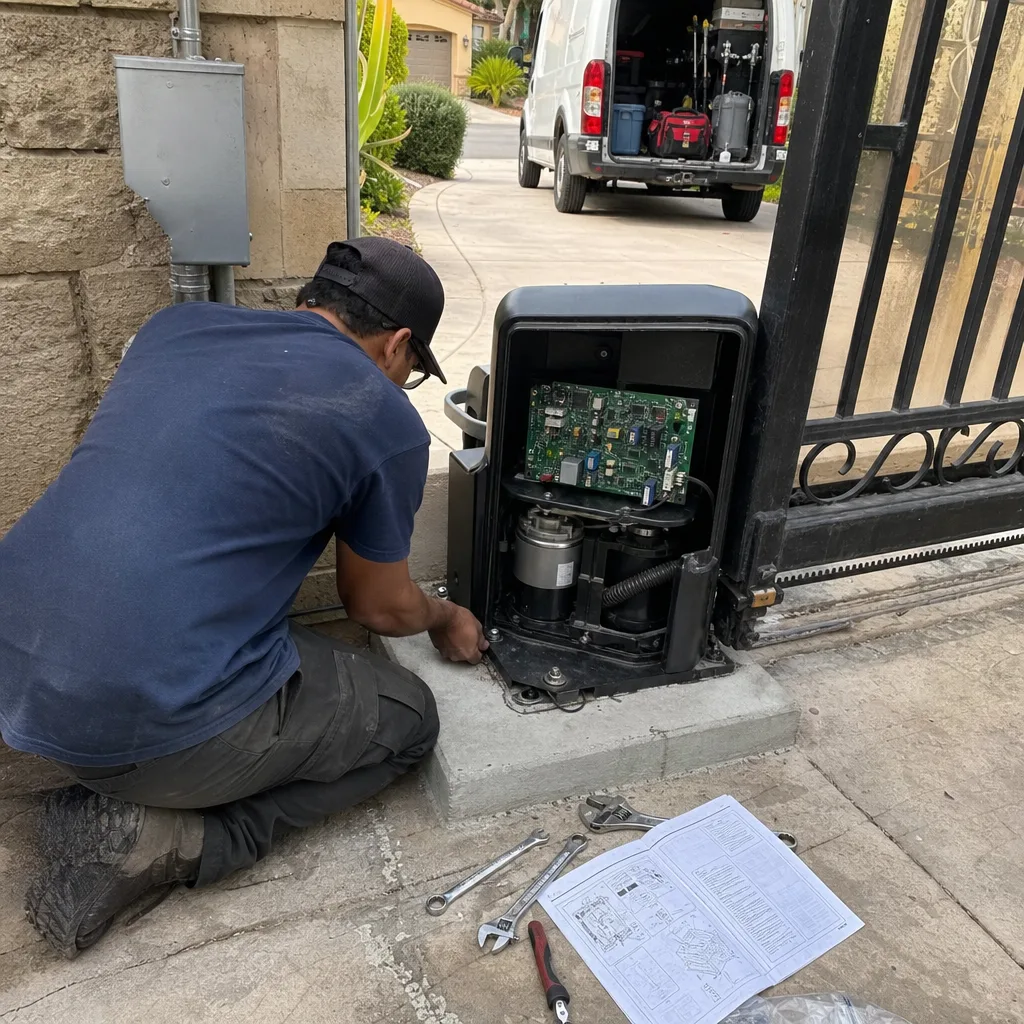
A gate that hesitates, whines, or shows rust at the hinges is a gate reporting its condition before it fails. The difference between a $200 repair and a $1,500 replacement is whether you act on that report. In Camarillo’s coastal environment, the pre-failure window is shorter than inland homeowners experience, so early recognition matters more. Document what you see, time the hesitation, photograph the corrosion, and call with specific numbers instead of vague symptoms. Our more guides & resources section has additional homeowner checklists you can use. A written price before work starts, a documented record of what was found and fixed, and a live person on the phone at any hour are the standards every Camarillo homeowner should expect from a gate repair company. That’s the evidence-first approach to gate repair, and it’s the only approach that respects both your time and your budget.
Written by Adrian Vance, Owner at Vance Gate Repair Camarillo, serving Camarillo since 2014.